Rethinking next generation WTG sub-components
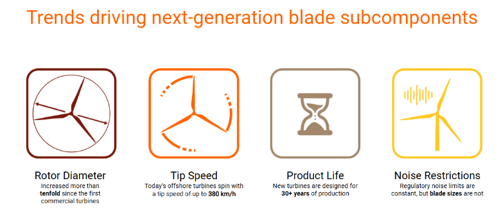
As rotor diameters increase more than tenfold from the first commercial turbines and tip speeds approach 400 km/h, the operational boundaries are being redrawn. With new assets designed for 30+ years of production life, the components affixed to these blades face immense physical demands far beyond the assumptions of the past.
A lot has happened since 1994, when Polytech started supplying Vestas V27, where tip speed was around half of today’s blade tip speed.
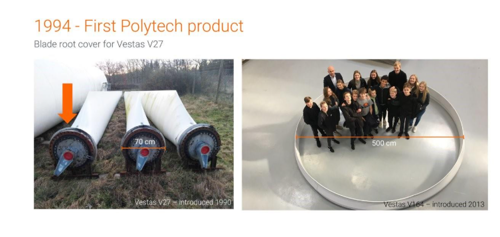 This relentless pursuit of a lower levelized cost of energy (LCOE) means that the subcomponents that protect, enhance, and ensure the performance of the blade itself-from aerodynamic add-ons that quieten the blade to protectors that shield it-are no longer commodity parts. They have become mission-critical systems that directly impact an asset's lifetime performance, reliability, and ultimately, its bankability.
High-Performance Material Systems
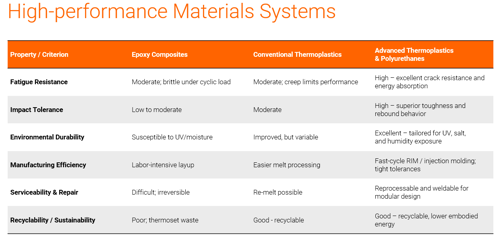
To meet the challenges of longer life and harsher conditions, the industry must pivot from conventional plastics to advanced material systems. Engineered thermoplastics and polyurethanes are redefining subcomponent performance, offering the extended fatigue life, impact resistance, and environmental durability that modern turbines require.
Material innovation is accelerating to meet specific load, thermal, and lifecycle requirements. The focus is on a precise balance of properties:
-
Superior Durability: High crack resistance, toughness, and energy absorption are non-negotiable for withstanding decades of impacts, vibration, and fatigue.
-
Environmental Resilience: Formulations must provide exceptional resistance to UV radiation, salt spray, and humidity-a critical factor for the burgeoning offshore sector and harsh coastal sites.
-
Hybrid Formulations: Innovation is now centered on tuning material properties by creating hybrid systems-combining the distinct advantages of thermoplastics, polyurethanes, and various reinforcements to create optimized compounds for each specific application.
Scalable, Precise Manufacturing
Advanced materials can only deliver their full potential when paired with equally advanced and scalable manufacturing processes. Two complementary technologies form the pillars of this approach, creating a complete manufacturing toolbox for next-generation blade subcomponents:
Precision Through Pressure (Injection Molding): By injecting molten thermoplastic at high pressure, this process delivers tightly controlled and repeatable geometries. It is ideal for the high-volume production of small, complex subcomponents where repeatable accuracy is paramount.
Strength Through Chemistry (Reaction Injection Molding): In this process, reactive polyurethane systems fill large, intricate molds under low pressure. It is perfectly suited for producing lightweight, durable parts with exceptional impact and fatigue resistance, such as structural housings or protective elements.
Process advancements-including automated mixing, closed-loop controls, and multi-material co-molding-are unlocking greater consistency and design flexibility, enabling the production of precision components at the scale required by global OEMs.
Innovation in Design & Integration
Material selection and manufacturing are critical, but the final piece is how these advanced components are integrated into the blade system. An expertly engineered component will fail if it is not properly attached. Therefore, a holistic, systems-level approach to design and integration is necessary.
The bond line itself is a critical interface, and smart bonding solutions are enabling faster assembly, stronger joints, and simplified maintenance. Innovation in this area includes:
-
Pressure-sensitive adhesives (PSAs) offer speed and simplicity for rapid, repeatable installation.
-
Reactive structural adhesives that provide the enduring strength required for permanent, high-load interfaces.
-
Hybrid bonding strategies, which combine a PSA for immediate fixture with a reactive adhesive for long-term structural strength, are becoming a preferred method for optimizing both factory assembly and in-field performance.
The future of wind energy rests on this full-system integration: connecting advanced materials, digital manufacturing, and circular design principles. It is through this partnership-driven, systems-level approach that the industry will achieve lighter, stronger, and longer-lasting turbine blades, unlocking the next frontier of performance.