Polytech has chosen to be involved in a landmark project to commercialize a new generation of HVDC (High-Voltage Direct Current) subsea electrodes. The standardized self-protecting design is set to revolutionize the construction of offshore interconnectors, delivering independently verified cost savings of double euro million digits for a typical 1GW project compared to today's solutions.
Supported by a grant from the Danish Energy Technology Development and Demonstration Program (EUDP), the project addresses a critical bottleneck in the global expansion of green energy. While HVDC links are essential for transmitting power from offshore wind farms and connecting national grids, the subsea electrodes required have traditionally been costly, custom-built, and fragile.
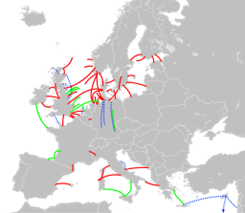
HVDC-links in Europe (Red: existing, Green: under construction, Blue, planned
Current methods require expensive secondary installation campaigns to dump rocks or concrete structures, forming a protective barrier around the electrodes. Polytech's innovation eliminates this entire step. The significant cost savings, which stem from a radical reduction in vessel time and the elimination of protective barriers, have been substantiated through independent validation of the system's design and robustness by the global engineering consultancy, WSP. Together with the other project participants (Aalborg University Esbjerg, Rosenberg Consulting and Energy Cluster Denmark) the project focus on verifying the design principles even further, by testing, modeling and finally a full-scale demonstration.
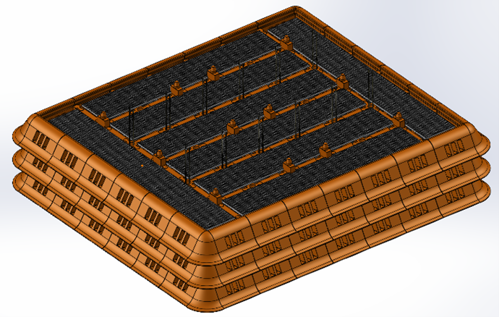
Three or more electrodes can be stacked at the vessel, reducing the installation time.
"We are moving from a complex, project-by-project approach to a robust, 'plug-and-play' solution," says Søren Find Madsen, Project Leader at Polytech.

"Our design is inherently robust, removing the need for costly and environmentally disruptive secondary protection. This makes the rollout of vital energy infrastructure faster, cheaper, and greener."
Full-Scale Demonstration with Danish TSO Energinet
Adding significant weight to the project, the technology will be proven in a full-scale demonstration in partnership with the Danish national transmission system operator (TSO), Energinet. The prototype electrode will be installed at an existing HVDC Link between Denmark and Germany.
"This collaboration with Energinet provides the ultimate validation, proving our hardware in a live operational environment alongside a key commercial partner," adds Madsen.
Built on Decades of Unseen Expertise
This hardware innovation is the physical manifestation of Polytech’s decades-long global leadership in a highly specialized domain: modelling the complex effects of large-scale current transmission through seawater and polyurethane (PUR) material understanding and production.

"For years, our core business has been to calculate how sea return currents interact with other marine assets like pipelines and communication cables, and engineer solutions to ensure the stray current mitigation and prevent accelerated galvanic corrosion," explains Steven Bray, Subsea Business Development Manager at Polytech.
"We are the experts in how current behaves in the water. Building the hardware that puts the current there is the natural and definitive next step. This deep system knowledge is our unique advantage."
By creating a market-ready, off-the-shelf solution, Polytech is set to accelerate the development of offshore wind and secure international grid connections, positioning Danish technology at the forefront of the global energy transition.