The wind industry is currently leaking thousands of dollars in value per asset due to a critical oversight: the logistics quality gap. While engineering has mastered the art of building 15MW giants, EBITDA is being eroded by components that are damaged, corroded, or lost before they even generate their first kilowatt-hour. At Polytech, we aren't just theorizing about these risks.
With 5,000+ trackers tested in real-life environments and more than 1.800.000 days logged for several OEMs, our insights are grounded in the data of thousands of global journeys. This scale of field evidence allows us to turn the supply chain "black hole" into a transparent, competitive advantage.
In today’s high-stakes environment, the difference between an OEM’s profit and loss is increasingly decided between the factory gate and final commissioning.
The dry chain: Fighting the silent killer
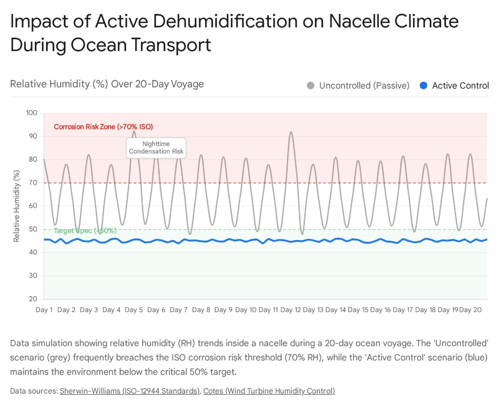
Humidity is the silent killer of wind assets. A deviation of just 15% in relative humidity inside a converter cabinet can slash the lifespan of electronics modules by years. We advocate for a "dry chain" methodology: an unbroken environmental custody from the moment a component leaves the factory until it is energized.
-
Active vs. Passive: While silica gel has its place, long sea voyages demand active adsorption dehumidification. Unlike condensation dryers that freeze in cold climates, adsorption rotors pull moisture from the air even at sub-zero temperatures.
-
The Bottom Line: A failure caught during commissioning might cost $10,000, but a humidity-induced failure offshore five years later can exceed $200,000 per event, excluding lost production revenue.
From disposable to circular: optimizing transport hardware
Historically, the industry has treated massive steel frames and cradles as disposable packaging. This represents a significant leakage of value.
-
The Idle Asset Problem: A set of transport frames can cost upwards of $100,000. When these sits forgotten in a laydown yard, it is a direct hit to return on Invested capital (ROIC).
-
The Universal Solution: By shifting toward modular, universal transport frames that stack and nest for return journeys, we can slash logistics CAPEX by 10% to 15%.
Digital pulse: eliminating supply chain black holes
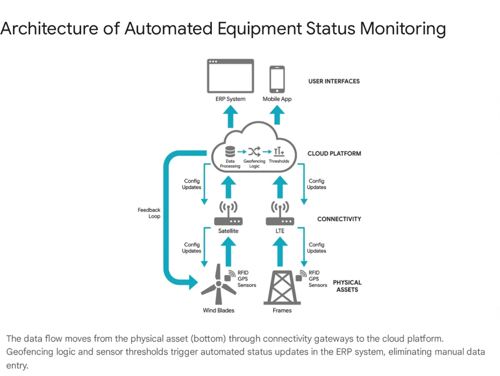
We cannot manage what we cannot see. The era of managing billion-dollar projects via manual spreadsheets must end.
-
Automated Status: Utilizing IoT telemetry and geofencing, components now broadcast their own status. We do not just track where a frame is, but its state: empty, loaded, or damaged.
-
Forensic Monitoring: With modern 80m+ carbon blades, monitoring shock exposure is non-negotiable. If a blade experiences a high G-force event during transit, we must know before it is bolted to a hub 150 meters in the air.
The path forward
The Levelized Cost of Energy (LCOE) is no longer determined solely by wind speed. It is determined by the integrity of the supply chain. By mastering these variables, we do more than save money; we ensure the clean energy assets we build are robust enough to power the future.
At Polytech, we are committed to closing this quality gap. In the race to net zero, we cannot afford to lose the promise of renewable energy in transit.
Learn more about our Transport Track & Protect solutions and request a free tracker right here.